Creative Vibe Coding · AI-Assisted Design & Development · 2023 — Now

AI didn't change
how I work.

It became how I work. I started using AI tools in 2023 out of curiosity. Today they are part of every phase — from the first research question to the last line of code.

The Journey — A Short Timeline

  1. 2023

    Experiment

    First contact with generative AI tools — Midjourney, early ChatGPT, image generation for concepting. Used experimentally: exploring what these tools could do, where they failed, and where they surprised. Not yet part of a workflow — more like a new material to understand.

  2. 2024

    Integration

    AI enters the production pipeline. Runway Gen-3, Kling AI, Nano Banana 2 for photorealistic video content, persona generation, and cinematic transitions — for real client projects at DocCheck. Prompt engineering becomes a discipline, not an afterthought. First AI-generated content delivered at client quality.

  3. 2025

    Development

    Claude and Claude Code enter the stack. AI moves from content generation into design thinking and code. First Creative Vibe Coding sessions — prototyping interactions, building browser tools, exploring what a designer-developer hybrid can build alone in a day.

  4. 2026

    Production

    Creative Vibe Coding at full scope. BannerFactura conceived, developed, and deployed — a production tool built solo with Claude Code, used by the agency team. SVN // VJ Controller — ~5,100 lines of Three.js, GLSL, and Web Audio in a single HTML file. AI is now part of every phase: research, ideation, design, prototyping, implementation.

Featured — Academic Context

When AI became something you could walk through.

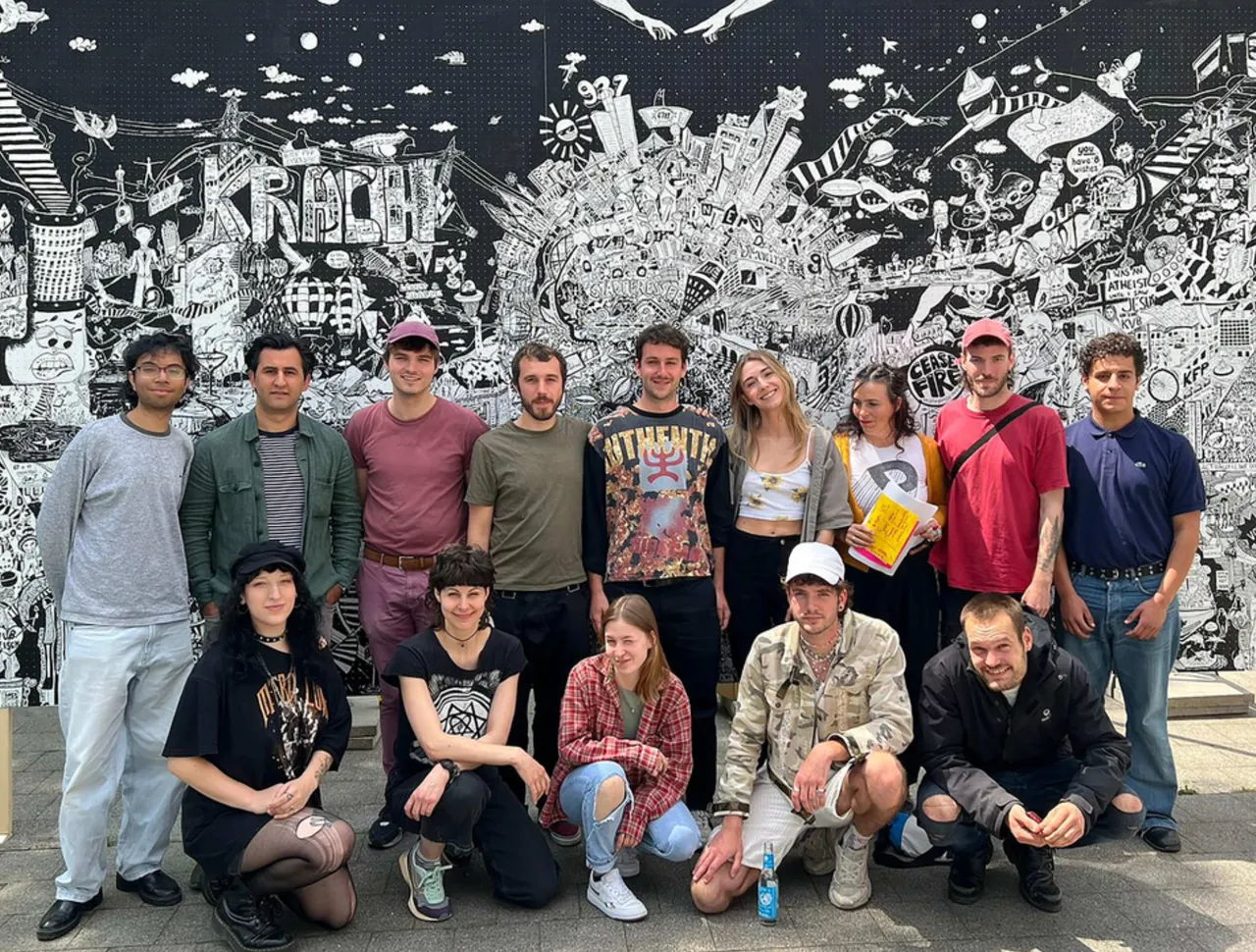
In June 2024, I was part of a project that pushed AI out of the screen and into physical space. Motion Experience Lab@(A)IDLE MODE was a 200 m² immersive installation that staged an artificial intelligence as something you could enter, move through, and become part of — built by 23 students under the direction of Prof. Nina Juric at KISD, and presented live at the HIDDEN LAYERS AIxDESIGN Conference at TH Köln.

The installation turned visitors into data points inside a performative AI system: seven interactive stations, each exploring the concept of (A)IDLE MODE — the latent state where a machine waits, processes in the background, and holds potential before activation. Real-time media, TouchDesigner, StreamDiffusion, and spatial choreography merged into a single living system.

I worked on two of the seven stations: Visible Input Layer — Who is the MXL AI? and On the Database — Performing TouchDesigner / Mediaplay. Both dealt directly with how an AI perceives, processes, and performs — translated into space, motion, and real-time interaction.

The project was published as part of un/learn ai, a peer-reviewed, BMBF-funded publication series on AI in design education. It's the academic counterpart to everything else on this page: proof that my engagement with AI didn't start as a production shortcut, but as genuine research into what these systems are, how they behave, and how design can make them tangible.

Video documentation — immersive installation · HIDDEN LAYERS Conference 2024
Video documentation — On the Database · TouchDesigner / Mediaplay
Visible Input Layer station from Motion Experience Lab (A)IDLE MODE
Still image — Visible Input Layer · Who is the MXL AI?

Motion Experience Lab@(A)IDLE MODE · KISD, 2024 · Published in un/learn ai (KITeGG, BMBF) · Project lead: Prof. Nina Juric

Read the full article →

How AI Works Across My Process

Research

I use AI to compress the distance between a new domain and a working understanding of it. When BannerFactura required knowledge of four different ad server specifications, I used Claude to map the technical requirements, identify the differences, and structure the implementation logic — before writing a line of code. AI as research partner means I can move into unfamiliar territory faster and with more precision than documentation alone allows.

Design & Ideation

Generative image tools have changed how I concept. I use Midjourney, Nano Banana 2, and Runway not to replace design decisions but to externalize them faster — to see three visual directions in the time it would take to sketch one. The design judgement is mine. The speed is AI’s. This is especially true for spatial concepts, UI mood explorations, and motion storyboards where iteration speed directly affects the quality of the final decision.

Development

Claude Code is where Creative Vibe Coding becomes most literal. I bring the concept, the interaction logic, the design intent, and the domain knowledge. Claude handles the implementation gaps — API structures, shader mathematics, export pipeline architecture. The result is code that reflects real design thinking, not boilerplate generated without context. I review, redirect, and refine everything. The output is mine — Claude is the speed.

Communication & Preparation

Before building BannerFactura, I spoke to every person in the existing workflow — project managers, developers, UI/UX designers, motion designers. AI helped me structure those conversations, synthesize the feedback, and translate it into a technical brief. Good tools start with listening. AI helps me listen better and build faster.

In Practice — Two Builds

BannerFactura

Workflow Optimisation Tool

An internal production tool that automates the full pipeline from Figma frame to export-ready HTML5 banner across four ad server formats. Conceived after speaking to every stakeholder in the existing workflow. Built solo with Claude and Claude Code. Runs in production at DocCheck.

SVN // VJ Controller

AV Performance Instrument

A browser-based AV performance instrument for DJs and live artists — ~5,100 lines of Three.js, custom GLSL shaders, MediaPipe hand tracking, and Web Audio API in a single HTML file. Conceived, designed, and built solo. Zero dependencies. No build step. Open the browser, start the set.

Both projects exist because I had a clear problem, a wide enough technical range to know it was solvable, and AI to bridge the gap between where my expertise ended and where the solution needed to go.

Why It Matters

Creative Vibe Coding is not a trend I adopted. It is a working method I developed over three years of deliberate experimentation — starting from curiosity, moving through integration, arriving at a practice that now covers the full creative and technical spectrum of my work.

What it enables is a specific kind of independence: the ability to take a problem from first principles to finished product, without a handoff, without a waiting period, without a team that needs to be assembled. For studios and agencies that need people who can move fast, think broadly, and deliver without friction — that independence is not a bonus. It is the point.

Rotkehlchen Runner | Mobile Mini Game + Trailer | Made with Unity

iFrame with interactive 3D content. Move, rotate, zoom and play in the Logo Space. On mobile you can control the scene with two touchpoints.